A daily newsletter on everything going on in global macro, covering everything from interest rates, foreign exchange, oil and precious metals prices to sanctions and macro policy
By subscribing, you agree to Substack's Terms of Use, and acknowledge its Information Collection Notice and Privacy Policy.
### It’s hard to sound hawkish in the press conference when you haven’t actually hiked
_Thank you for subscribing to my posts. If you’re not yet a paying supporter, please consider becoming one. That’ll allow you to DM me with questions and comments. Your contribution will help cover the cost of the data I use in my posts, which I fund out of my own pocket. Thanks so much for your support and feedback!_
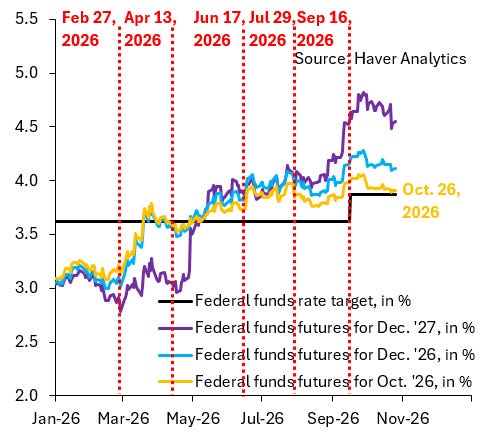
After the Fed didn’t hike at its July 29 meeting, markets threw a tantrum. The US yield curve bear-steepened and there was lots of chatter about the loss of Fed credibility in the fight to bring inflation down. That episode clearly touched a nerve. It sparked the surprise buyback announcement by the Treasury on August 19 and the hawkish pivot by Warsh at Jackson Hole, which presaged the unanimous hike on September 16.
Given the ferocity with which markets went after Warsh this summer, I’m surprised how docile they’re being now. After all, markets went into the July 29 meeting pricing ten basis points in hikes after a core CPI reading that was flat just two weeks earlier. Now they’re pricing only three basis points for tomorrow - as the orange line in the chart above shows - even though CPI had an upside surprise two weeks ago and the midterms are around the corner. If markets are worried about political capture of the Fed, I’d have thought this would be the meeting to really test Warsh. The key question is how fragile the truce between markets and the Fed is and if there’s anything that can happen on Wednesday to upset things. That’s what I discuss next.
The table above is my two-by-two matrix for how I think about tomorrow’s Fed. The Fed’s statement and rate decision become public at 2 pm (ET) and are followed by the press conference at 2:30 pm (ET). These are discrete events and the tone of the press conference ends up being way more important than the actual interest rate decision.
So what can we say about the press conference on Wednesday? First, it’s clear the Fed isn’t going to hike given where market pricing is, so that’s a natural limit on just how hawkish the press conference can be. After all, if Warsh sounds all-out hawkish, he’ll inevitably get asked why they didn’t just hike this week. That’s a conversation Warsh will want to steer clear of. Second, Warsh did a nice job explaining the Fed’s hawkish shift from July in the September press conference. He gave three reasons: (i) growth had been stronger than expected; (ii) inflation hadn’t come down fast enough; and (iii) oil prices were rising (the September meeting was just after the attack on the Saudi East-West pipeline). The growth outlook is weaker now given rising concern AI is a bubble. That’s offset by stubborn inflation and oil prices that are higher than in the run-up to September 16. In the two-by-two matrix above, this puts us somewhere on the lower row between the left (C) and right (D) quadrants, so the press conference should be broadly neutral for markets.
If I had to guess, the Fed wants this meeting - just ahead of the midterms - to stay as much out of the limelight as possible. The midterms are fraught enough already. This is no time for a hawkish surprise, not even in the press conference.
A daily newsletter on everything going on in global macro, covering everything from interest rates, foreign exchange, oil and precious metals prices to sanctions and macro policy
By subscribing, you agree to Substack's Terms of Use, and acknowledge its Information Collection Notice and Privacy Policy.
They should hike and send the signal that inflation cannot be tolerated even if the job market is a little soft and the govt thinks inflating our way out of a debt crisis might be a good idea. These carefully orchestrated and parsed press conferences are meaningless everywhere but Wall Street.