Stefan Gerlach writes about monetary policy as it is actually practiced. Based in Zurich, he is Chief Economist at EFG Bank and a former Deputy Governor of the Central Bank of Ireland.
By subscribing, you agree to Substack's Terms of Use, and acknowledge its Information Collection Notice and Privacy Policy.
# Sweden: Is the Riksbank Behind the Curve?
##### **Summary:** Swedish inflation has fallen to exceptionally low levels, yet the economy is recovering and the Riksbank has begun raising interest rates. With new forecasts due on 16 December, is the Bank planning enough tightening to contain inflation in 2027?
Thanks for reading Gerlach Macro Notes! Subscribe for free to receive new posts and support my work.
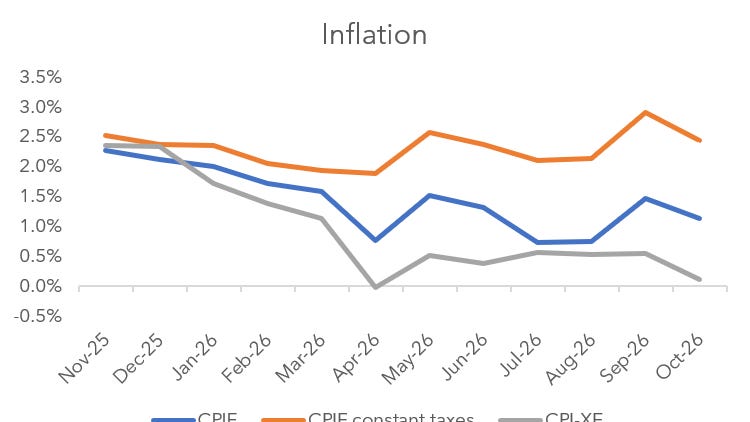
Swedish inflation is not as low as it appears. Tax reductions, including cuts in fuel taxes and food VAT, have lowered measured inflation during 2026. In October, CPIF inflation was just 1.1%, while CPIF excluding energy (CPIF-XE) fell to 0.1%. However, CPIF inflation at constant taxes was 2.4%.
In a presentation to parliament on 19 November, Governor Erik Thedéen reported estimates excluding the direct effects of temporary fiscal measures. On this basis, CPIF inflation was 2.5%, while the corresponding measure excluding energy was 1.1%, considerably above the published 0.1%.
Nevertheless, underlying inflation has recently declined. CPIF inflation at constant taxes fell from 2.9% in September to 2.4% in October, while the Riksbank’s adjusted measure excluding energy declined from 1.6% to 1.1%. Thus, underlying price pressures are stronger than published inflation suggests, but there is little evidence that they are currently accelerating.
Meanwhile, the economy is recovering. Household consumption and retail sales have strengthened, although industrial production has lost momentum. More importantly, business confidence as captured by the PMIs is above normal, suggesting that firms expect the recovery to continue and broaden.
The labour market is also improving gradually. Unemployment has declined from 8.8% in 2025 to 8.6% in October, while the employment rate has risen from 68.8% in early 2025 to 69.5%. Nevertheless, unemployment remains elevated, and there is little evidence of accelerating domestic inflation.
The Riksbank’s main concern is that cost pressures are building upstream. Prices of intermediate goods supplied to the Swedish market have risen sharply, with annual inflation reaching 6% in September even excluding energy. These increases have so far had limited effects on consumer inflation. But as demand strengthens, firms may find it easier to pass higher costs on to consumers. The Riksbank expects both CPIF and underlying inflation to rise above 2% in 2027, reflecting stronger demand, supply disruptions and the weaker krona.
This explains the Riksbank’s increasingly hawkish stance. It began 2026 expecting to leave rates unchanged at 1.75%. As the recovery strengthened, it revised its interest-rate outlook upwards. In November, it raised rates to 2% and indicated that further tightening was likely, broadly in line with its September forecast.