### China’s oil imports have risen in line with Persian Gulf supply - it’s NOT panic buying
_Thank you for subscribing to my posts. If you’re not yet a paying supporter, please consider becoming one. That’ll allow you to DM me with questions and comments. Your contribution will help cover the cost of the data I use in my posts, which I fund out of my own pocket. Thanks so much for your support and feedback!_
Ever since the war with Iran began, people have ascribed a special role to China. When oil prices didn’t rise to $150 or $200 in March and April, the story that got told was that China cut its imports and played global stabilizer. That’s wrong as I’ve laid out in a series of posts. China’s oil imports did fall in the early stages of the conflict, but that’s because the Strait of Hormuz was seriously encumbered and then Iran was blockaded by the US. China’s imports fell in line with everyone else’s, so it wasn’t the marginal price setter. China is just another bozo on the bus in this war.
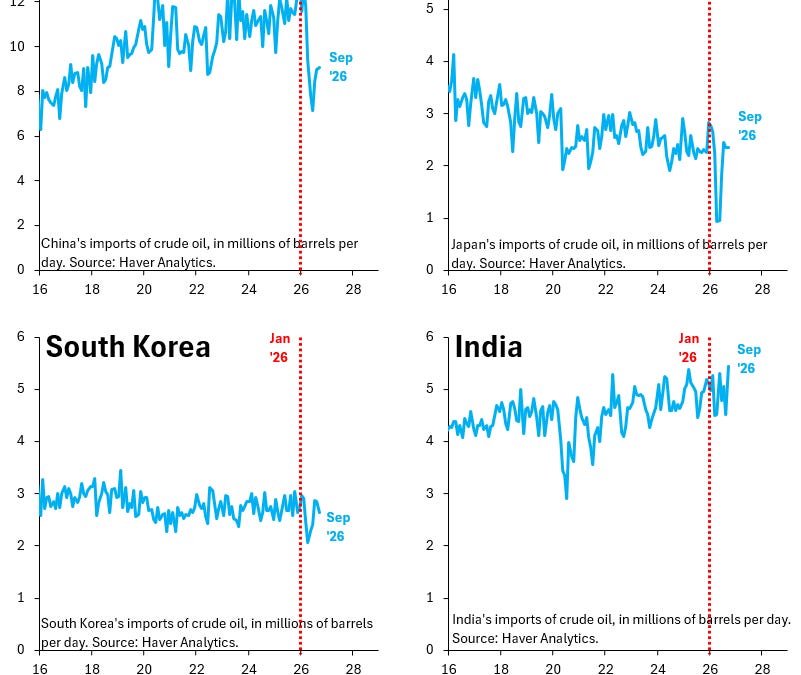
The China narrative has now gone into reverse. Many are ascribing the current spike in Brent to China needing to replenish inventories that were run down. There’s no sign of that. China is currently importing around nine million barrels of oil per day versus eleven million before the war. The missing two million is the blockade of Iran, so - adjusting for the blockade - China is back to normal. It’s not panic buying or replenishing inventories.
The bottom line is China isn’t why Brent is at $116. Instead, the reason is a big risk premium that anticipates a resumption of US bombing runs after the midterms. This risk premium is disconnected from current supply fundamentals for oil.
The charts above show imports of crude oil in millions of barrels per day (mb/d) by China (top left), Japan (top right), South Korea (bottom left) and India (bottom right). These data are monthly and the last observation is September 2026, so this is pretty close to current. China’s imports are currently around 9 mb/d versus 11 mb/d before the war. Factoring in that China was pretty much the only buyer of Iran’s oil exports before the war (which ran near 2 mb/d), China is back to normal. There’s no sign it’s stepped up imports to refill stockpiles. Indeed, the opposite is true. It’s still below normal because the hole from Iran is going unfilled. Japan and South Korea are back to pre-war levels of around 2.5 mb/d. Only India is slightly above pre-war levels and stands at 5.4 mb/d in September 2026 versus 4.9 mb/d in September 2025.
Of course, it’s possible oil imports picked up this month as the realization has hit we may be going back into a hot war. My gut is that’s not what’s happening. Supply out of the Gulf has normalized and so has buying by key countries in Asia. Demand is just moving with supply. This means the recent rise in Brent isn’t about these guys. It’s just panic buying due to fears of a return to all-out war and thus a big risk premium that’s disconnected from flow fundamentals as they currently stand.
A daily newsletter on everything going on in global macro, covering everything from interest rates, foreign exchange, oil and precious metals prices to sanctions and macro policy
By subscribing, you agree to Substack's Terms of Use, and acknowledge its Information Collection Notice and Privacy Policy.
Interesting how a change in oil imports can tell a much bigger story about global politics. It’s a good reminder that energy security isn’t just about how much oil a country has, but also where it comes from and how reliable those suppliers are.
China went from importing 12 million barrels a day to 6 million barrels a day. At the height of the disruption, peak global oil supply losses reached 14 million barrels per day. So yes, China undeniably played a crucial role in stabilising the oil market, simply because it's such a big importer of oil (without much economic damage to its economy). But no, it did not intend to do that, it just happened. And one should indeed also not exaggerate its role.
There are several more important and interesting questions: why did (produced oil import) demand behave more price-elastically than economic textbooks traditionally predict? Was China's (produced oil import)demand more elastic than the demand of other countries, and if so, why? Was total oil demand also more price elastic than expected? Evidently, the fact that China imported 6 million barrels a day less does not mean that its demand for oil declined with 6 million barrels (it produces 30% of its oil consumption and has huge reserves).