A daily newsletter on everything going on in global macro, covering everything from interest rates, foreign exchange, oil and precious metals prices to sanctions and macro policy
By subscribing, you agree to Substack's Terms of Use, and acknowledge its Information Collection Notice and Privacy Policy.
### What the debt sell-off in France is about and what it’s not about
_Thank you for subscribing to my posts. If you’re not yet a paying supporter, please consider becoming one. That’ll allow you to DM me with questions and comments. Your contribution will help cover the cost of the data I use in my posts, which I fund out of my own pocket. Thanks so much for your support and feedback!_
I’ve been on the alarmist end of the spectrum on global debt and France specifically for quite some time. In recent weeks, French government bond yields have exploded higher and there’s a whiff of panic in the market, with all kinds of apocalyptic stories going around. This post is a quick update on what **is** going on and what **is not**.
What’s happening is the violent unwind of a carry trade into French debt that built as oil prices tumbled in June after the signing of the MoU between the US and Iran. This means French yields won’t spike indefinitely. Once this unwind is done, French yields will stop rising. So this is **NOT** an open-ended fiscal crash. France completed almost 90 percent of its issuance needs for this year and can do the rest issuing short-term debt. France also has continued market access, so this is **NOT** a liquidity or solvency event. It’s nothing like the crisis in Greece over a decade ago.
So the good news is that this sell-off is a contained event and reflects a carry trade gone bad as oil prices have spiked. But life is never simple in the Euro zone, where there’s lots of other fiscal basket cases. The risk of contagion to Italy is very high and when I use the word _“contagion”_ that’s really a misnomer. Italy has real vulnerabilities of its own. This is why what’s going on in France is so important. If France gets a lot worse, it’ll undoubtedly spill over to the rest of the high-debt sovereigns in the Euro zone and then we have a systemic crisis on our hands. I put a 30 percent probability on this happening by end-2026. This is my roadmap for how things play out.
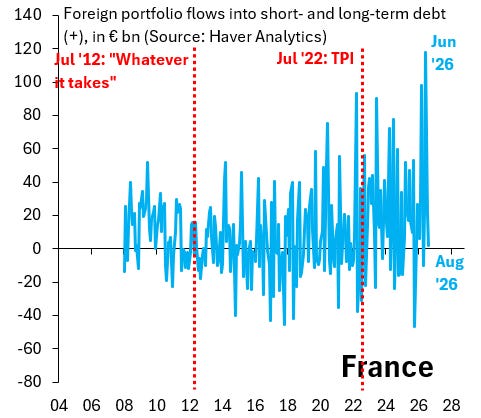
I yesterday put out a post on how what’s going on in France is the violent unwind of a carry trade into French government debt that built a few months ago. The blue line in the chart above is monthly data on foreign flows into (+) French debt. These got to an all-time high in June 2026 when Iran and the US signed the MoU and oil prices were tumbling. Markets bet oil prices would stay low and identified French debt as one of the biggest beneficiaries. That’s why the recent rise in oil prices has caused France to blow up. France has basically become a casualty of the ups and downs in oil prices.
The black line in the chart above is the front-month Brent futures price. The blue line is the spread on the 10-year French government bond yield over German Bunds. The vertical red lines are my usual flags for key turning points in the war with Iran: (i) the start of the war in the night of Feb. 27; (ii) the initial imposition of the US blockade of Iran on Apr. 13; (iii) the signing of the MoU on Jun. 17; (iv) the reimposition of the US blockade on Jul. 14; and (v) the attack on the Saudi East-West pipeline on Sep. 10. It’s the last thing that set off the latest rise in oil prices - driven by an underlying spike in shipping costs - and this is what’s triggered the unwind of all the flows into French government bonds, which - after all - were predicated on oil prices staying low.
The reason France got so much worse so quickly is because French debt unwittingly became a derivative trade of oil prices. A fiscally distressed country like France will benefit greatly if oil prices fall back and stay low. That’s what markets gambled back in June and it’s why the recent spike in oil prices sent the French spread soaring. The good news is that carry trade unwinds don’t last indefinitely. Once this unwind ends, French yields should stop spiking the way they have in recent months. Hopefully that buys France some time to get its house in order.
A daily newsletter on everything going on in global macro, covering everything from interest rates, foreign exchange, oil and precious metals prices to sanctions and macro policy
By subscribing, you agree to Substack's Terms of Use, and acknowledge its Information Collection Notice and Privacy Policy.