A daily newsletter on everything going on in global macro, covering everything from interest rates, foreign exchange, oil and precious metals prices to sanctions and macro policy
By subscribing, you agree to Substack's Terms of Use, and acknowledge its Information Collection Notice and Privacy Policy.
# How the AI Sell-Off Reveals Fiscal Strain
### Long Treasury yields aren’t down despite the AI rout, so their rise is about big deficits
_Thank you for subscribing to my posts. If you’re not yet a paying supporter, please consider becoming one. That’ll allow you to DM me with questions and comments. Your contribution will help cover the cost of the data I use in my posts, which I fund out of my own pocket. Thanks so much for your support and feedback!_
I’ve done lots of work documenting the rise in long-term Treasury yields over the past year. While there’s little doubt that long-end yields are in uncharted territory - they’ve risen above levels that prevailed before the global financial crisis - it’s less clear what’s driving this. On one end of the spectrum are people like me who think this is a rising fiscal risk premium as our public debt grows out of control. On the other end are folks who say it’s hyperscaler debt issuance that’s pushing up yields, so there’s no sign fiscal policy’s in trouble. I’m skeptical of the latter view because corporate dissaving - where hyperscaler debt issuance shows up in macro data - isn’t remotely near where it was in the IT bubble of the early 2000s. Instead, it’s public dissaving that looks big relative to history and is thus more likely to be driving up yields, at least in my mind.
This week’s AI sell-off is the perfect _“natural experiment”_ to help us figure out what’s going on. If the AI buildout really has been driving up long yields, you’d think they’d be falling now as markets worry about tighter data center permitting and regulations. This post shows this week’s AI sell-off had essentially no impact on yields. That runs counter to the narrative that AI is behind the rise in long yields and therefore lends credence to the fiscal risk premium argument.
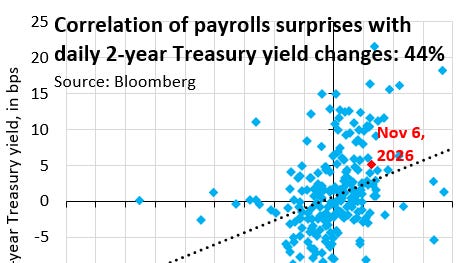
I do two things to investigate the link between yields and AI. The horizontal axis in the chart above shows payrolls surprises relative to the Bloomberg consensus scaled by the historical standard deviation of these surprises. Take yesterday. Consensus for payrolls in Bloomberg was 70k. The actual number came in at 165k, so that’s an upside surprise of 95k. The historical standard deviation of these surprises is 76k, so that’s a 1.2 standard deviation upside surprise. As the red rhomboid shows, the two-year yield rose five basis points and that’s what’s shown on the vertical axis. This rise in the two-year yield is more than you’d expect if you thought AI was a big part of the US growth story. If anything, you’d have thought that the red rhomboid would be below the black regression line that gives you the average response of yields to payrolls surprises. This short-term perspective - based on how markets traded after yesterday’s payrolls - runs counter to the idea that US growth depends critically on AI and thus also runs against the notion that AI pushed up yields.
The second thing I do to examine the link between yields and AI is the chart above. The black line shows daily data from the start of 2026 for the two-year Treasury yield. The blue line is the 10-year yield and the purple line is the 10y10y forward yield. If the AI bubble were a material driver of the rise in long-term yields, the purple line should have fallen this week alongside the blue and black ones. It didn’t and that in my mind further cements the case for the fiscal risk premium.
The midterm elections and the AI sell-off that’s ensued have given us the perfect natural experiment to disentangle what’s going on with long-term yields. They’re up because of mounting fiscal stress, not because of AI. Once the war ends - and it will - we’ll be left with all the structural challenges the US and others in the G10 face. The fact that we’re rapidly running out of fiscal space is top of that list.
A daily newsletter on everything going on in global macro, covering everything from interest rates, foreign exchange, oil and precious metals prices to sanctions and macro policy
By subscribing, you agree to Substack's Terms of Use, and acknowledge its Information Collection Notice and Privacy Policy.