A daily newsletter on everything going on in global macro, covering everything from interest rates, foreign exchange, oil and precious metals prices to sanctions and macro policy
By subscribing, you agree to Substack's Terms of Use, and acknowledge its Information Collection Notice and Privacy Policy.
### How is US fiscal policy ever going to get fixed if the Fed caps yields in bad shocks?
_Thank you for subscribing to my posts. If you’re not yet a paying supporter, please consider becoming one. That’ll allow you to DM me with questions and comments. Your contribution will help cover the cost of the data I use in my posts, which I fund out of my own pocket. Thanks so much for your support and feedback!_
It’s considered good form these days to wring your hands about fiscal policy, but things are more complicated than that. Policy makers - like all humans - respond to incentives and those are that the Treasury market won’t ever really blow up because the Fed steps in to cap yields if things get really bad. The best example of this is when COVID first hit and Treasury yields spiked in March 2020. The official version of that episode is that instability in global markets caused the basis trade to blow up, so the Fed had to intervene to cap yields. But there’s another version, which is that markets pushed up yields because they correctly anticipated massive deficit spending, which made rising yields perfectly justifiable.
The Fed’s emergency intervention and the QE program that followed were all about creating fiscal space, but - looking forward - what incentive do policy makers have to ever get the budget under control if this is how we run things? The lesson that should have been learned from COVID is that the world is an unpredictable place and it’d be better to budget cautiously. That wasn’t the lesson learned. The aftermath of COVID was all about proponents of MMT (Modern Monetary Theory) claiming deficits don’t matter. The world’s central banks are the key enablers of bad fiscal policy and the Fed is unfortunately no exception.
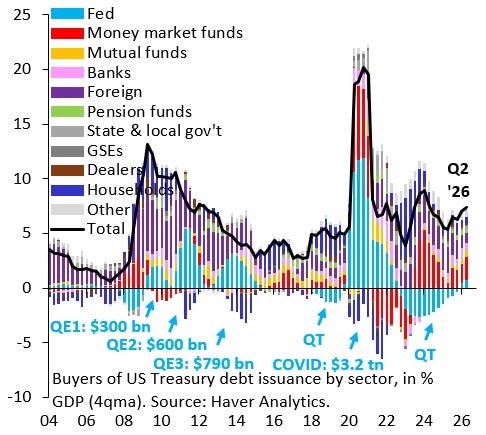
The black line in the chart above is net new debt issuance by the US, so you can think of this basically as our budget deficit. The bars of different colors are who’s buying all this debt where my focus is on the light blue bars, which are net buying of Treasuries by the Fed. I’ve denoted successive Fed QE programs with arrows and there’s two big stylized facts. First, every QE program is bigger than the last, with what happened in COVID totally off the charts. Second, when the Fed does quantitative tightening (QT), it never goes back to the _**status quo ex ante**_, so lots of Treasuries that get bought stay on its balance sheet permanently and just get rolled over.
This runs counter to how QE was supposed to work when it began in 2009. Back then, the story was that this was an extension of countercyclical monetary policy at the zero lower bound. This should have seen Treasuries roll off the Fed’s balance sheet rapidly after the global financial crisis (and for that matter after COVID), but instead they’re permanently warehoused. You can forgive people for calling this monetary financing and in my opinion this is why yields in the US are artificially low, i.e. shadow yields - what yields would be without all this Fed activity - are way higher than what we see.
There’s a direct read-across to fiscal policy. First, if yields are artificially low and shadow yields are actually quite a bit higher than what we observe, fiscal policy is in a much worse place than meets the eye. So when people argue that debt isn’t an issue because yields are low, they’re missing the key role the Fed plays. Second, imagine the AI bubble bursts, the stock market goes into a 40 percent correction and US activity collapses. QE has become normalized, so it’ll obviously be part of the Fed’s response. Once again, this’ll be done to make room for fiscal stimulus, so there’s no adverse hit policy makers will feel from all the years of giant deficits in the aftermath of COVID. If we want fiscal policy to get fixed, this all starts and ends with the Fed. If the Fed again caps yields in the next shock, it’ll just be doubling down on bad incentives for our politicians and fiscal policy will keep getting worse.
A daily newsletter on everything going on in global macro, covering everything from interest rates, foreign exchange, oil and precious metals prices to sanctions and macro policy
By subscribing, you agree to Substack's Terms of Use, and acknowledge its Information Collection Notice and Privacy Policy.
Every single fiat currency system has eventually collapsed, lost its value, or been abandoned, with an average lifespan of around 27 - 35 years. Why would it be fundamentally 'different this time'? Our fiat money is created through loans, issued by the commercial banking system (fractional reserve banking) and its credibility is, in theory, protected by 'independent' central banks. Everything is fine, as long as that banking system is not endangered. During the GFC it was about to implode, due to bad mortgage loans, but it was rescued by governments and central banks (QE). Now, it is sovereign debt that is increasingly becoming problematic and 'bad'. If/when this threatens the banking system and the epic credit boom, nurtured by this system, central banks will, once again come to the rescue. But that will come at a price. https://www.haver.com/articles/interest-on-the-public-debt-is-a-metastasizing-budgetary-cancer