A daily newsletter on everything going on in global macro, covering everything from interest rates, foreign exchange, oil and precious metals prices to sanctions and macro policy
By subscribing, you agree to Substack's Terms of Use, and acknowledge its Information Collection Notice and Privacy Policy.
### The blockade of Iran relies on a “fear factor,” which has been lost after the midterms
_Thank you for subscribing to my posts. If you’re not yet a paying supporter, please consider becoming one. That’ll allow you to DM me with questions and comments. Your contribution will help cover the cost of the data I use in my posts, which I fund out of my own pocket. Thanks so much for your support and feedback!_
Economic warfare - like actual warfare - has a heavy psychological component. You want your adversary to think: _“This is hopeless, I might as well give up.”_ That element has been on the side of the US since the start of the blockade, but now - with the crushing loss of Republicans in the midterm elections - it’s been lost. Iran knows circumstances will change fundamentally in the US once the new Congress is sworn in, which means it just has to ride out the next two months. Another round of bombing isn’t going to change that and the _“fear factor”_ of the blockade is fading.
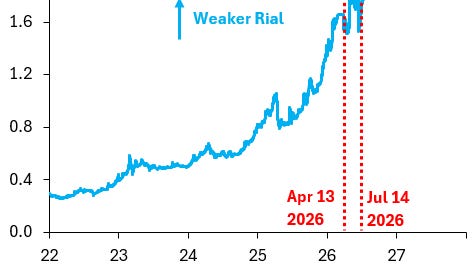
Today’s post documents fading depreciation pressure on the Iranian Rial, which had a meaningful rebound after the midterm election results became known on November 4. That’s a symptom of the fading _“fear factor”_ the US can exert on the regime. There are ways to reestablish this _“fear factor,”_ but they involve extreme military escalation in the very short term with the goal of convincing the regime it can’t possibly hold out until the new year. The window for such escalation - realistically - has closed.
The chart above shows Iran’s exchange rate, which has been weakening sharply since the reimposition of the blockade on July 14. This weakening is a symptom of capital flight, which is Iranians saying: _“this is hopeless, we’re taking our money out.”_ As I argued in my series of posts on the blockade, it’s this capital flight that most immediately hits the regime by tightening financial conditions, making it harder for Iran to sustain its economy and thus its actions to interfere with tanker traffic in the Strait of Hormuz.
Now look at the chart above, which plots the same data as in the first chart, except that I’m now looking at the daily change in the Rial versus the US Dollar. When the bars are positive, the Rial strengthens against the Dollar, while it falls when they’re negative. Look at when the Rial has strengthened, which I’ve highlighted in red. The first appreciation episode is mid-June in the run-up to the signing of the MoU and the lifting of the blockade. Capital flows returned to Iran as the _“fear factor”_ diminished. There’s another big positive reading on September 13 right after the attack on the East-West pipeline, which brought capital back into the country on the perception the regime had landed an important blow. And then there’s November 4 - the day after the midterms - when the Rial had an almost two standard deviation rise against the Dollar as the fear factor of the blockade fades. The psychological component of the blockade, which is so critical in putting the regime under pressure, has unfortunately been lost.
The US now has three options. The first is a massive military escalation as soon as possible to convince the regime it can’t possibly hold out until January. The second is to do a series of strikes that will be mostly performative in nature and allow the US to declare _“mission accomplished.”_ The third is to call it quits and leave it to countries in the Persian Gulf to buy off Iran and pacify the Strait of Hormuz. Realistically, I think it’s fair to say that the window for the kind of military escalation it would take to alter the regime’s thinking has closed. That leaves us with options two and three and that’s where I think we’ll end up. The Saudis are minting money from the rise in oil prices and have plenty of cash to throw around. They - along with others in the region - can easily buy off the regime. That can be accompanied by a series of strikes to degrade Iran’s ability to attack ships in the Strait, making the regime more amenable to a deal.
There are larger lessons from this whole episode. This war was a mistake from the beginning, but President Trump deserves credit for imposing the blockade. That took courage and - had we done the same to Russia in 2022 - I’m convinced that the war in Ukraine would be long over. The blockade should have been imposed sooner, but it’s also true that March and April were when all kinds of apocalyptic oil price forecasts were making the rounds, so there was understandable reluctance to take Iran’s oil off global markets. What we learned after the first imposition of the blockade on April 13 is that oil prices didn’t spike out of control, that demand destruction happened in an orderly manner and that Western economies weathered this shock admirably. That’s an important lesson for the future. The next time we confront an autocratic energy exporter, we shouldn’t delay imposing a blockade. We should do it right away. And of course it’s not too late for Europe - without the US - to shut down Russia’s shadow fleet in the Baltic, which would be a softer version of a blockade.
But, as far as Iran goes, it’s time to call a spade a spade and end things. The midterms mean the _“fear factor”_ of the blockade has been lost because Iran knows it can now run down the clock. Military action isn’t going to change that.
A daily newsletter on everything going on in global macro, covering everything from interest rates, foreign exchange, oil and precious metals prices to sanctions and macro policy