A daily newsletter on everything going on in global macro, covering everything from interest rates, foreign exchange, oil and precious metals prices to sanctions and macro policy
By subscribing, you agree to Substack's Terms of Use, and acknowledge its Information Collection Notice and Privacy Policy.
### Maybe some family fights are good, but not the one that’s going on now at the Fed
_Thank you for subscribing to my posts. If you’re not yet a paying supporter, please consider becoming one. That’ll allow you to DM me with questions and comments. Your contribution will help cover the cost of the data I use in my posts, which I fund out of my own pocket. Thanks so much for your support and feedback!_
When Kevin Warsh took over as Fed Chair earlier this year, he liked to describe the Fed’s rate setting debate as having a _“good family fight.”_ It’s likely he no longer feels quite as enthusiastic about this as in the June press conference when he first made that analogy. What Warsh forgot is that a lot rides on what kind of family you have.
If the family in question is massively dysfunctional and there’s lots of bruised egos, a family fight just lands you with a visit from social services. In my view, that’s where we’ve ended up in this particular family fight:
* A chair who’s come out against forward guidance, even as the rest of the FOMC is falling over themselves giving speeches on where they think policy should go.
* A chair who’s against tying policy to individual data points, but then Waller ties a 50 basis point hike in December directly to the outturn of the October core CPI.
* A chair who’s unwilling or unable to steer the debate, most critically on the role that this year’s oil price spikes have played in keeping inflation high.
In short, this family fight is a mess and - more importantly - may be causing serious damage in markets. I flagged yesterday that the sharp rise in real interest rates that’s a direct consequence of all this is causing unusual moves in the Dollar as well as gold and other precious metals. Sudden moves in financial markets are always a financial stability risk and this is no exception. This post reviews where financial stability risk stands, which is something I track on an ongoing basis. The Fed and its family fight may be well on their way to causing a market _“accident.”_
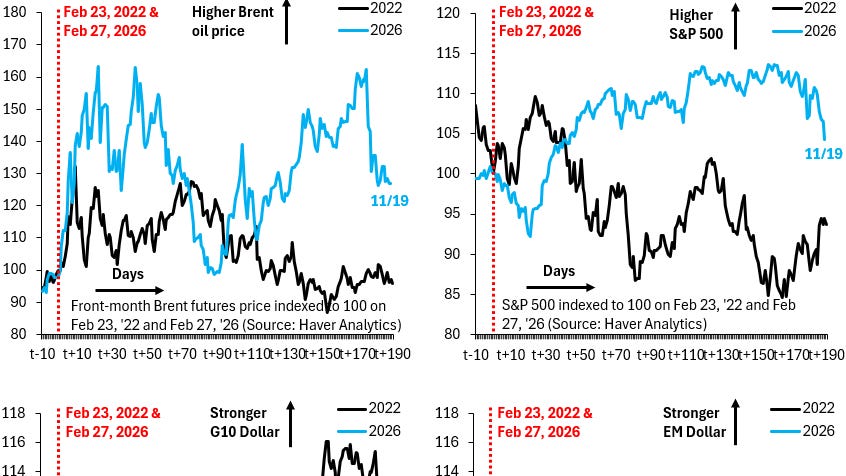
In the past, I’ve used 2022 as a benchmark for what’s going on in 2026 and I think this is still a good comparator. Russia’s Ukraine invasion spiked oil prices in 2022, which is similar to what’s been going on this year with the Iran war. 2022 was also the post-COVID recovery when the Fed was hiking rates, so again there’s a parallel with now. If financial stability indicators look better now than in 2022, that’s a good sign. After all, we got through that year without a meaningful blowup, so that bodes well for now. If financial stability indicators look stretched compared to 2022, we may be in trouble.
Like in my previous posts, I look at spot and options markets. The former is where directional views are expressed, so - if you’re certain oil is going to rise - you’ll go long oil in this market. If, in contrast, you’re worried about rising uncertainty and tail risk, you’ll hedge this in options markets. Hedging often runs well ahead of directional views, so the swings in options markets can be more violent than in spot. Thus, if options markets look more or less in line with 2022 - an episode markets navigated successfully - this bodes well for where we are now.