A daily newsletter on everything going on in global macro, covering everything from interest rates, foreign exchange, oil and precious metals prices to sanctions and macro policy
By subscribing, you agree to Substack's Terms of Use, and acknowledge its Information Collection Notice and Privacy Policy.
### There’s far too much slack in the global economy for a genuine inflation scare
_Thank you for subscribing to my posts. If you’re not yet a paying supporter, please consider becoming one. That’ll allow you to DM me with questions and comments. Your contribution will help cover the cost of the data I use in my posts, which I fund out of my own pocket. Thanks so much for your support and feedback!_
So I didn’t have on my bingo card that oil would fall sharply and the Dollar would go through the roof. The drop in oil - Brent is down over 20 percent so far in November - should have moved market pricing for the Fed in a dovish direction, but the opposite played out this week thanks to a hawkish speech by Fed Governor Waller and a _“hot”_ CPI. In my opinion, the divergence of Fed pricing from oil is unsustainable and noise. This means this week’s sharp rise in the Dollar can’t last and gold and other precious metals should rebound, but I recognize there’s lots of pushback to my view.
Today’s post goes back to basics and lays out why I remain a Dollar bear. If you think the Fed is behind the curve and needs to hike a lot, this is because you think inflation is broadening out, i.e. the supply shock from oil is spreading out to lots of other items in the CPI. This can happen when the economy is booming, which gives retailers and producers lots of pricing power, allowing them to pass the oil shock on to consumers. If the economy is booming, GDP should be above _“potential,”_ the level of activity that’s consistent with stable inflation. There is no evidence that’s true for the US or for any other advanced economy. If anything, the opposite is true. There’s lots of slack - spare capacity - in the global economy that’s deflationary. This is why I believe strongly that this week’s _“hot”_ CPI is noise and Waller’s hawkishness is a red herring.
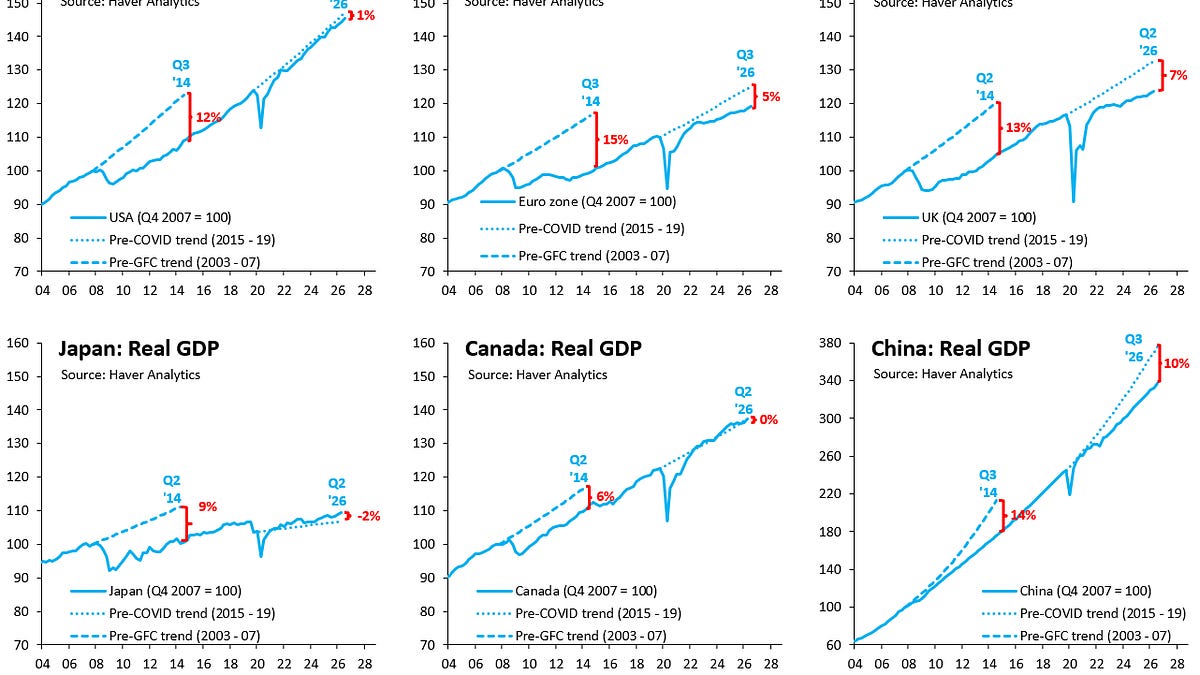
The solid blue lines in the charts above are the level of real GDP for the US (top left), the Euro zone (top middle), the UK (top right), Japan (bottom left), Canada (bottom middle) and China (bottom right). I’ve indexed them to be 100 in Q4 2007 in all cases and every chart is on the same scale except for China, which grows much faster than the rest. The bold dashed lines in each chart extrapolate forward the level of GDP if growth post-global financial crisis had stayed at its pre-2008 trend. The thin dashed lines show what GDP would have been if growth had remained at its pre-COVID trend. If the solid line is below the dotted lines, that’s a sign of slack, i.e. there’s an output gap (GDP < potential). If the solid line is above the dotted lines, that’s a sign the economy is overheating and demand-driven inflation could be taking root.
The bottom line across these charts is that there’s no sign of GDP above potential anywhere. The US has GDP currently one percent below its pre-COVID trend, the Euro zone is five percent below, the UK seven percent below and China a stunning ten percent below. Canada has a gap of zero, i.e. GDP is at potential, and Japan is technically above potential, but its GDP is so stagnant this is hardly inflationary. It’s true that slack isn’t as big as in the years after the global financial crisis, but it’s still true that GDP is below its pre-COVID trend pretty much everywhere. The world just isn’t in a place right now where inflation can genuinely take off.
What does this mean for now? I showed in a post on Tuesday that the _“hot”_ CPI is almost certainly noise and reflects temporary spillovers from the September and October spike in oil prices. These spillovers will fade now that oil prices have fallen, which was also true earlier this year when oil prices fell. The degree of slack in the global economy makes a genuine inflation scare impossible and means the market is way over its skis on pricing a hawkish Fed. The bottom line is that my dovish inflation view comes down to the large amount of slack in the global economy.
A daily newsletter on everything going on in global macro, covering everything from interest rates, foreign exchange, oil and precious metals prices to sanctions and macro policy
By subscribing, you agree to Substack's Terms of Use, and acknowledge its Information Collection Notice and Privacy Policy.
Do you actually go to the grocery store? Have you paid an electric bill lately? Have you gone car shopping? Do you know any self employed people that have tried to get heath insurance lately? The average American is underwater and paying for necessities on their credit card and it’s not just at the gas station.