# How The Fed Should Talk About Inflation
### The claim that inflation isn’t falling fast enough just doesn’t cut it in an oil shock
_Thank you for subscribing to my posts. If you’re not yet a paying supporter, please consider becoming one. That’ll allow you to DM me with questions and comments. Your contribution will help cover the cost of the data I use in my posts, which I fund out of my own pocket. Thanks so much for your support and feedback!_
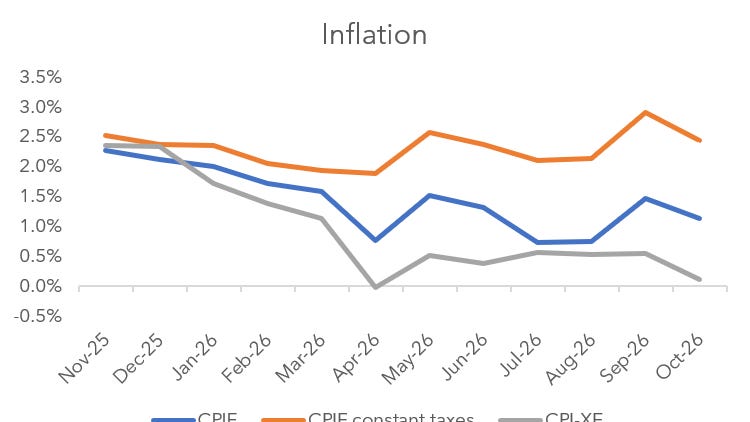
The Fed’s insistence on hikes stems from the mistaken belief that inflation isn’t slowing fast enough. In fact, this was pretty much the entire gist of the Jackson Hole keynote that Warsh gave in August, but this claim - that inflation isn’t coming down fast enough - is almost comically silly given repeated spikes in oil prices we’ve seen in the course of this year. Oil prices first spiked in March and April after the war with Iran began and again in September and October after the Saudi East-West pipeline got hit. Obviously these spikes are going to drive up inflation and what should matter for the Fed is what underlying inflation is doing once you take these shocks out.
For some reason, this basic decomposition didn’t feature in the Jackson Hole keynote and has also been absent from the recent run of hawkish Fed commentary, notably the call from Governor Waller earlier this month for a 50 basis point hike if core CPI was 0.3 percent or higher in its October reading. With all kinds of supply shocks floating around, there’s an urgent need for the Fed to change the way it talks about inflation. The rise in real rates that’s weighing on risk assets stems from a failure to do so.
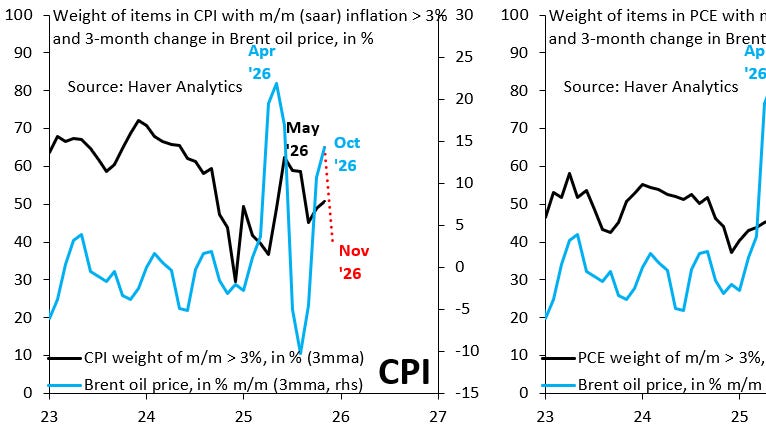
The black line in the left chart above is the weight of items in the CPI with month-over-month inflation above 3 percent. This measures the _“breadth”_ of inflation and is the metric Warsh referenced in his hawkish shift at Jackson Hole. This measure got pulled up by the oil price spike in March and April (blue line) and there’s no doubt in my mind that’s happening again in recent data given the September and October rise in oil prices. What matters - rather than just mechanically tracking this measure - is whether inflation _“breadth”_ falls back after the oil shock recedes. That’s clearly true after the March and April price spike and it’ll likely be true again given how much oil prices have fallen this month (red dotted line). The chart on the right is the exact same thing for PCE and the pattern is the same. Inflation _“breadth”_ rises as oil prices spike, but then falls back after the shock earlier this year recedes.
Talking about how inflation isn’t coming down fast enough - without disentangling supply shocks - is a bit ridiculous and in my opinion is one of the reason why the Fed’s hiking campaign is causing such ructions in markets. The Fed needs to go back to looking through supply shocks and that starts with acknowledging the role that the latest oil price spike has played in pushing up inflation in September and October.
A daily newsletter on everything going on in global macro, covering everything from interest rates, foreign exchange, oil and precious metals prices to sanctions and macro policy
By subscribing, you agree to Substack's Terms of Use, and acknowledge its Information Collection Notice and Privacy Policy.
I guess we are still all Keynesians, lol. I’ve been bemused all year to watch the sudden clamor for inflation fighting from unusual quarters. Now, where there are clearly supply shocks that are temporal if uncertain duration and this is cause for immediate inflation fighting action. I can only conclude there is so much anti Trump venom that they are willing to tank the economy and their own reputation to get him.
This seems clear…so…assuming Warsh is ‘not dumb’…there must another agenda that is making them hawkish? Thought experiment on a hidden agenda?
Gold prices are going through the roof and this isn't due to foreign central banks